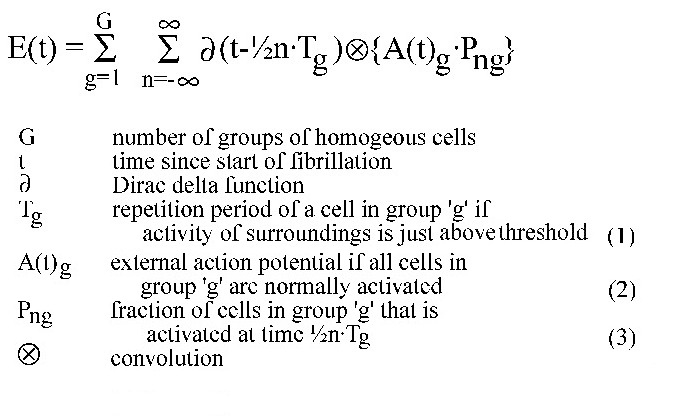
The extra-cellulary recorded electrical signal from the heart during ventricular fibrillation can be described as:
(2) Elaboration of function A(t)
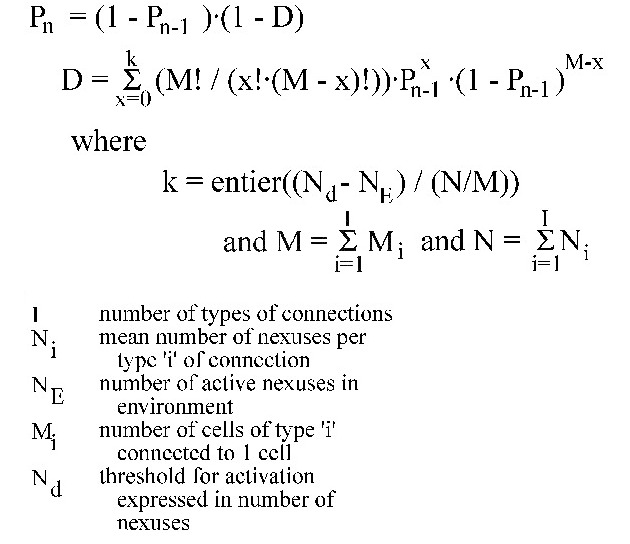
(3) Elaboration of function P
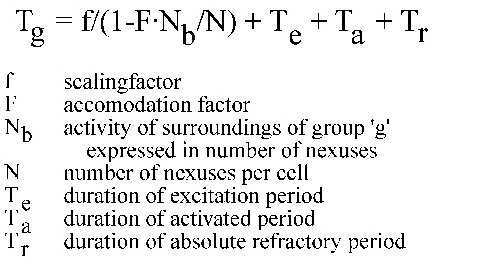
(1) Elaboration of function T
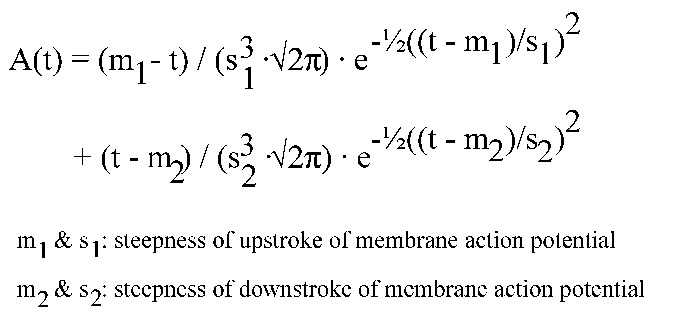
(2) Elaboration of function A(t)
(3) Elaboration of function P
Remark # 1
The functions T, A(t) and P have the suffix ‘g’, because every group ‘g’ is supposed to have its own parameters.
Remark # 2
The form of the function E(t) is chosen to facilitate the mathematical insight. All frequency domain analysis in this book is based upon Fourier transforms. The Fourier transform of a train of Delta functions is again a train of Delta functions and the Fourier transform of the exponential function is well defined too. The Fourier transform of a convolution of functions is equal to the product of the Fourier transforms of these functions. Now the mathematically inclined reader can easily verify the strong resemblance between the calculated spectra from function E(t) and the estimated spectra from electrocardiograms during ventricular fibrillation, including the time domain phenomena like pseudo waves!